
 By
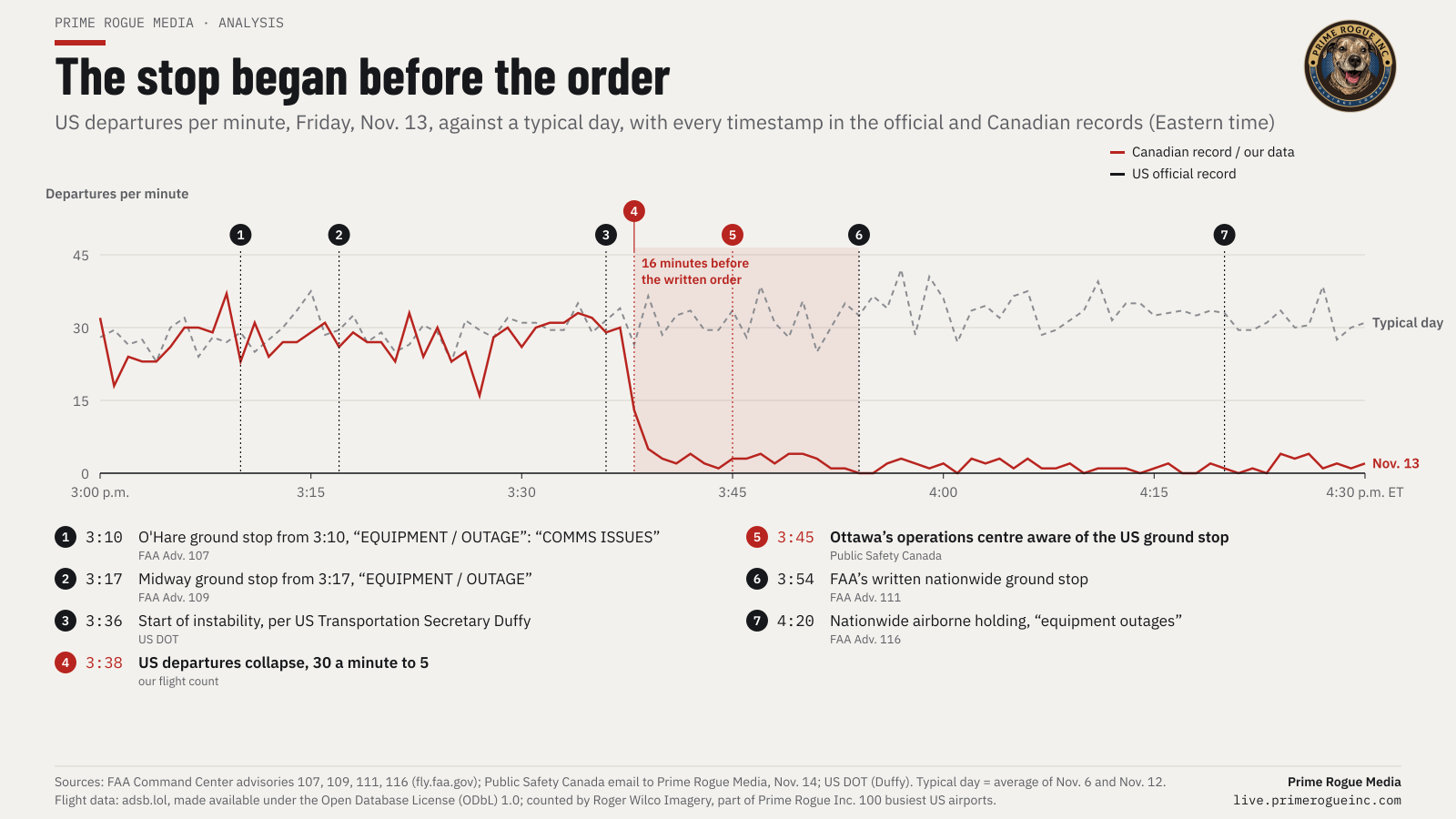
The official account of Friday's US aviation shutdown has a tidy shape: instability began at 3:36 p.m. Eastern, the FAA ordered every US airport to stop departures at 3:54 p.m., and the order was lifted at 8:19 p.m.
The FAA's own advisory record, and two records from the Canadian side, our own flight count and Ottawa's operations log, show the shutdown began earlier and in a messier way.
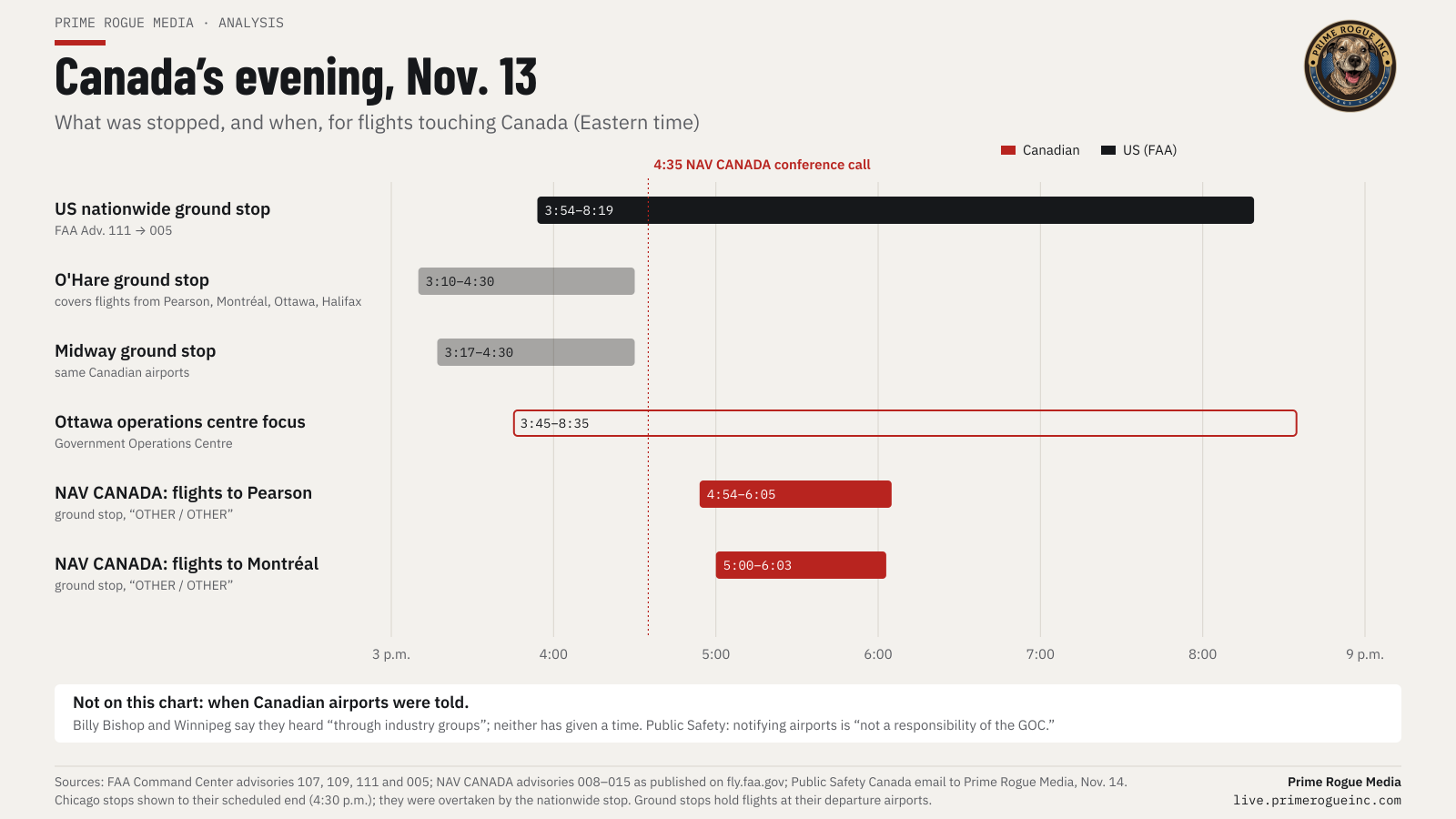
The Command Center's public advisory log shows a ground stop at Chicago O'Hare dated from 3:10 p.m. ET, for an "EQUIPMENT / OUTAGE" with the comment "COMMS ISSUES." That is 26 minutes before the time Transportation Secretary Sean Duffy gave for the start of the problem, and 44 minutes before the nationwide order. The O'Hare stop covered flights departing from Canadian airports, including Toronto, Montréal, Ottawa and Halifax.
Our count of flight-tracking data shows departures across the United States collapsing at 3:38 p.m., 16 minutes before the written nationwide order. And Canada's federal Government Operations Centre told us it was aware of the "US nationwide ground stop" at 3:45 p.m., nine minutes before the FAA issued it.
None of this shows anyone concealed anything. When an air traffic control centre loses communications, controllers stop releasing aircraft at once and put the paperwork in afterwards. What it does show is that the 3:54 p.m. time in most accounts dates the paperwork, not the stop.
What the FAA's record shows
The FAA's Air Traffic Control System Command Center publishes every advisory it issues on fly.faa.gov. On November 13 it issued 123. We read the ones issued between 3 and 6 p.m. ET.
- 3:21 p.m. Advisory 106 reported arrival delays and airborne holding of up to 30 minutes into O'Hare. Reason: "EQUIPMENT ISSUES." Constrained facility: Chicago Center (ZAU).
- 3:28 p.m. Advisory 107 put a ground stop on flights to O'Hare. Its stated ground stop period runs from 20:10 UTC, which is 3:10 p.m. ET, to 21:30 UTC. Impacting condition: "EQUIPMENT / OUTAGE." Comments: "COMMS ISSUES." The departure airports covered include every airport in NAV CANADA's Toronto flight information region, plus Halifax, Ottawa, Montréal-Trudeau and Toronto Pearson by name.
- 3:30 p.m. Advisory 108 activated the FAA's diversion recovery system for every airport. It gave no reason.
- 3:31 p.m. Advisory 109 put a ground stop on Chicago Midway, dated from 3:17 p.m., also for "EQUIPMENT / OUTAGE." It covered the same departure airports, again including Halifax, Ottawa, Montréal-Trudeau and Toronto Pearson.
- 3:54 p.m. Advisory 111, "NATIONAL GROUND STOP": "DUE TO EXTRAORDINARY CIRCUMSTANCES AND FOR REASONS OF SAFETY," all US airports were ground stopped "BY ORDER OF THE FEDERAL AVIATION COMMAND CENTER" (the advisory's wording). Inbound international flights would be "MANAGED ON A CASE BY CASE BASIS."
- 4:20 p.m. Advisory 116 warned of "NATION WIDE AIRBORNE HOLDING" at "any and all" US airports, "DUE EQUIPTMENT OUTAGES" (the misspelling is the FAA's).
- 5:46 p.m. Advisory 120 reissued the nationwide ground stop. Its reason was now "COMMUNICATIONS FAILURE," and flights would be released "as en route facilities recover."
- 8:19 p.m. Advisory 005 cancelled it.
Two things stand out. First, the stated reason for the national stop sharpened over two hours: from "extraordinary circumstances" and safety, to equipment outages, to communications failure. Second, the first equipment-related stops in the record are in Chicago, and they begin before 3:36 p.m.
The record does not say whether the Chicago trouble was the first stage of the national failure or a separate local fault that happened to come first. A ground stop's start time can also be entered after the fact. Advisory 107 was signed 18 minutes after the start time it gives. We have asked the FAA both questions.
Update, Nov. 16, 1:40 a.m. ET: the FAA's questions-and-answers page, dated Nov. 15, says the problem began at "approximately 3:30 p.m. ET" and points to a radar site in Amarillo, Texas, and a radio communications site in El Dorado, Arkansas. It does not mention Chicago. See the live update.
What Canada's records show
Canada was a bystander to Friday's failure. But Canadian records turn out to be useful witnesses to it.
Our flight count. Roger Wilco Imagery, part of Prime Rogue Inc., counted departures from the 100 busiest US airports, minute by minute, in the adsb.lol flight-tracking archive. About 30 aircraft took off each minute until 3:37 p.m. ET. Then 13 took off at 3:38, five at 3:39, and between none and four a minute after that. On the comparison days, the same minutes averaged about 30. The near-total halt began 16 minutes before the written nationwide order. (The Chicago stops alone don't show up as a national drop: departures nationally carried on at near-normal rates until 3:37.)
Ottawa's operations log. Public Safety Canada told us its Government Operations Centre, which runs around the clock, "became aware of the US nationwide ground stop as of 15:45 EST." That is nine minutes before the FAA's nationwide advisory existed. Public Safety did not say how the centre found out. Either someone told federal partners about a national stop before the FAA put it in writing, or the centre logged the moment it first heard of the disruption under the name the event later got. Either would be worth knowing, and we have asked.
The centre kept its focus on the event until 8:35 p.m. Public Safety said "US partners have informed the federal government that the cause of the disruption was a technical failure." That is the US account as relayed to Ottawa, not a Canadian finding.
NAV CANADA's own ground stops. The FAA's advisory site also carries NAV CANADA's advisories. They show NAV CANADA holding flights bound for Toronto Pearson from 4:54 p.m. ET and for Montréal-Trudeau from 5:00 p.m. at their departure airports. These were ground stops on traffic into Canada's two busiest hubs. At first they covered departures from everywhere; revisions narrowed them to flights from the United States. NAV CANADA cancelled them at 6:03 p.m. (Montréal) and 6:05 p.m. (Pearson), so each lasted a little over an hour. The stated condition was "OTHER / OTHER," with no comment.
Earlier, at 4:21 p.m., NAV CANADA's National Operations Centre had called a special conference call with airspace users for 4:35 p.m. to discuss the FAA's operations and constraints.
That matters because of a disagreement over words. On Friday, Porter Airlines attributed its system-wide cancellations to "a U.S. FAA outage & NAV Canada ground stops." NAV CANADA told us its measures at major Canadian airports were "precautionary" traffic management measures and did not use the words "ground stop." On Saturday Porter told us: "NAV Canada issued a ground stop at select airports for a very short period." NAV CANADA's own advisories back Porter. A ground stop is one kind of traffic management measure, so NAV CANADA's description wasn't false. But it described the measures in the most general terms available. No Calgary or Vancouver ground stop appears in the advisory list, though NAV CANADA said it had measures at both. NAV CANADA's routine 3:06 p.m. outlook, issued before the first Chicago trouble in the FAA's record, had already planned reduced arrival rates at Vancouver from 4:45 p.m. and at Calgary from 6 p.m. We have asked whether those are the measures it meant.
NAV CANADA has not yet answered our question about this.
Update, Nov. 15, 6:55 a.m. ET: flight-by-flight data shows five flights from Ottawa and Toronto flew into US airspace during the stop and turned back, two of them dispatched after US departures had stopped. See Five flights from Canada turned back.
Who told Canadian airports?
This is the question we started with, and it is still open.
Billy Bishop Toronto City Airport and Winnipeg's airport both told us they were notified "through industry groups." The Canadian Airports Council said it and its US parent "sent an update to its members as events unfolded," and described airports' channels to NAV CANADA as "well-established and effective." It did not say when it sent the update.
Asked whether notifying airports is its job, Public Safety said: "No, this is not a responsibility of the GOC," and referred us to Transport Canada. Transport Canada had earlier referred us to NAV CANADA and to Public Safety. NAV CANADA referred questions about the ground stop to the FAA. So did NORAD and CISA.
There may be a simple explanation. The FAA and NAV CANADA formally notify aircraft operators, meaning airlines, because a ground stop applies to flights. Airports may sit outside the formal notice chain by design. But no Canadian agency has yet told us it notifies airports of a foreign ground stop. Meanwhile the FAA's records show flights from four Canadian airports being held for Chicago from 3:10 p.m.
What we've asked
We have put these questions, with a deadline of noon ET Monday, November 16:
- FAA: When did the first communications problem occur, and at which facility? Was the 3:10 p.m. O'Hare stop the first stage of the outage? Were departures halted by phone before the 3:54 p.m. written order? When was NAV CANADA notified?
- Public Safety Canada: How did the Government Operations Centre learn of the stop at 3:45 p.m., and from whom? Did it issue a Flash Alert to federal partners?
- NAV CANADA: Why were the Pearson and Montréal ground stops issued, and why did it describe its measures as precautionary rather than as ground stops? Were the Calgary and Vancouver measures the arrival-rate reductions planned at 3:06 p.m.? When did the FAA's "immediate" notice arrive, and when did NAV CANADA first tell an airport?
- Transport Canada: Whose responsibility is it to notify Canadian airports of a foreign ground stop, and did anyone do so on November 13?
We will update this story with their answers.
How we did this
- FAA advisories: read on fly.faa.gov's public advisory database for November 13, 2026, on November 14. Times in advisories are UTC; we converted them to Eastern (UTC−5). We have archived the advisory list and screenshots of the advisories quoted here.
- Flight counts: adsb.lol's public archive, a volunteer receiver network, counted by Roger Wilco Imagery. Roger Wilco Imagery is part of Prime Rogue Inc., and its counts are automated. The network misses military, blocked and unequipped aircraft, so its counts aren't comparable with Flightradar24, FAA or airport figures. The comparison days are Friday, November 6, and Thursday, November 12. The archive day ends at 7 p.m. ET. Flight data: adsb.lol, made available under the Open Database License (ODbL) 1.0.
- Statements: emails to Prime Rogue Media from Public Safety Canada, NAV CANADA, Porter Airlines, the Canadian Airports Council, the Toronto Port Authority and the Winnipeg Airports Authority, November 13–14, all on the record.
- Duffy's 3:36 p.m. time: his public remarks on November 13, as reported by ABC News and in Roll Call's transcript.
- The full timeline, with a source for every timestamp, is on our live page.
Updates and corrections to this story will be noted here, with times.